
35 Billion Google Searches Occur Daily Worldwide

The fact that Google handles 3.5 billion searches daily is astounding. It indicates that Google has become the primary source of information worldwide, whether users are looking for products, services, or answers to their questions.
For businesses, this figure represents endless opportunities. Every search is a potential customer. If a website can rank at the top of relevant search results, it can attract substantial traffic. For example, a company selling coffee beans that ranks well for keywords like “buy coffee beans” can reach numerous coffee enthusiasts with purchasing intent every day. Therefore, SEO strategies must focus on optimising keywords with high conversion potential to take advantage of these 3.5 billion searches.
Reference: internetlivestats.com
Google Holds Nearly 90% of Global Search Engine Market Share

Google is the most widely used search engine worldwide, with a 95% market share on mobile devices and 82% on desktop devices. This high usage rate makes it the primary battleground for businesses engaging in digital marketing and SEO. The 95% market share on mobile devices, in particular, shows that mobile search is the growing trend.
This means businesses need to optimise their websites for mobile devices to ensure strong rankings in mobile search results. For example, restaurants can enhance their Google My Business Profiles and mobile websites, allowing nearby customers to quickly find information and increase foot traffic. Besides optimising mobile websites, businesses should also improve page load speeds and user experience to meet Google’s Core Web Vitals requirements.
Reference: statista.com
Google’s 2023 Total Revenue
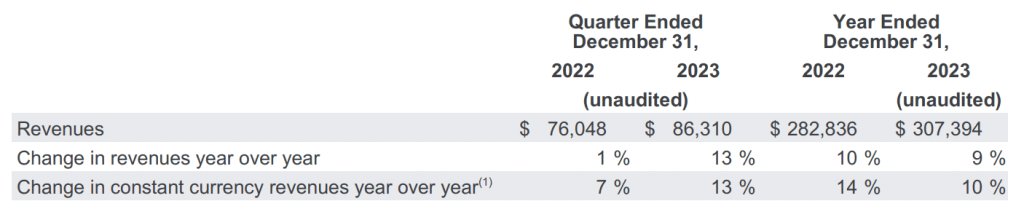
Google’s massive revenue showcases its influence and dominance in the global digital advertising and search markets.
For businesses, this highlights the importance of investing in SEO. Optimising websites to improve search rankings can generate more business opportunities and revenue. For example, a small e-commerce company that improves its product page rankings through SEO optimization may see an increase in website traffic and sales, significantly boosting its revenue. Therefore, businesses should continue investing in SEO resources to leverage Google’s massive traffic to promote their products and services, ultimately achieving a higher return on investment.
Reference: Alphabet 2023財務報表
51% of Users Discover New Brands Through Mobile Search

The data shows that mobile search is crucial for brand exposure and acquiring new customers. For businesses, SEO is key to improving website rankings and attracting more new customers.
For example, a newly opened restaurant that optimises its Google My Business profile and SEO strategy can rank higher in search results for “restaurants near me,” attracting many new customers. This reminds businesses to prioritise mobile SEO optimisation to ensure they stand out during consumers’ search process, attracting potential customers.
Reference: thinkwithgoogle.com
Featured Snippets Occupy Over 50% of First-Page Search Results

Featured snippets are short pieces of text displayed at the top of the search results page, directly answering users’ questions. These snippets hold 50-65% of first-page positions, giving them significant visibility and click-through rates.
For businesses, this presents a huge opportunity. By optimising content to answer common questions or provide valuable information, a website has a chance to be selected as a featured snippet, significantly increasing traffic. For instance, a health blog can create detailed and valuable content addressing questions like “How to lose weight.” If Google selects this content as a featured snippet, it will attract a substantial number of clicks and readers. This shows that SEO strategies should focus not only on improving keyword rankings but also on creating high-quality content that answers users’ questions to aim for the featured snippet position.
Reference: authorityhacker.com
15% of Searches Have Never Been Searched Before

15% of daily searches are entirely new, showing users’ continuous demand for new information. For SEO, this highlights the growing importance of long-tail keywords.
Long-tail keywords are often more specific and less competitive, but they attract a more targeted audience. For example, a company that specializes in handcrafted leather goods can optimise for a long-tail keyword like “custom handmade leather wallets Hong Kong,” instead of just “handmade leather wallets.” This strategy can help rank higher more easily and attract customers with genuine buying intent, improving conversion rates. Therefore, businesses should invest more resources in researching and optimising long-tail keywords and creating valuable content to meet new search demands.
95% of Keywords Are Searched Less Than 10 Times Per Month
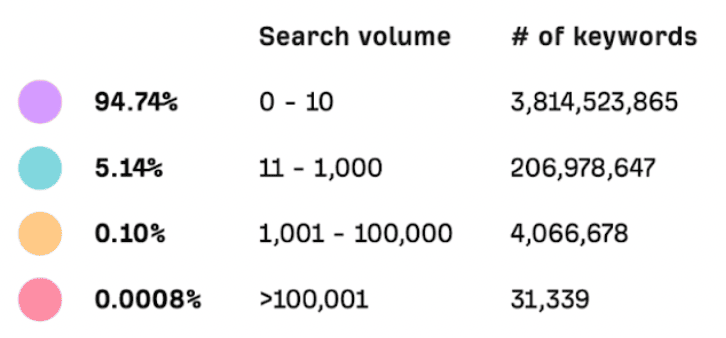
This shows that most keywords have very low search volume, but that doesn’t mean they’re without value. On the contrary, these low-volume keywords tend to be more targeted and attract a more precise audience.
For instance, a gardening blog could optimise for long-tail keywords like “how to grow organic tomatoes.” Although this keyword may have low search volume, users searching for it are usually highly interested and in need, leading to higher conversion rates. This reminds us not to focus solely on high-search-volume keywords but to leverage long-tail keywords for steady, targeted traffic.
Reference: ahrefs.com
96% of Web Pages Receive Zero Search Traffic from Google
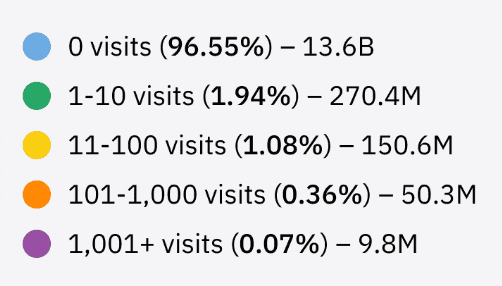
Ahrefs’ analysis of 1.4 billion global web pages reveals that 96% of web pages fail to receive any search traffic, which is an alarming statistic. There are three main reasons for this:
- The topic of the page has no search demand: If the content isn’t something users care about, it will struggle to get traffic, no matter how well-optimised it is.
- The page lacks backlinks: Backlinks are a vital indicator of page authority for search engines, and a lack of them will affect rankings.
- The page doesn’t match search intent: Content that doesn’t meet users’ needs will naturally fail to receive clicks.
This reminds businesses that SEO isn’t just about keyword optimisation; it also requires content relevancy, value, and active backlink building.
Conclusion
These 8 statistics reveal some intriguing trends and facts. As AI technology continues to advance and search engine algorithms evolve, businesses’ marketing strategies become more complex and crucial. In 2024, SEO strategies should emphasise the use of long-tail keywords, content quality, and value to stand out in this competitive market and gain more exposure and customers.
SRC is a digital marketing company in Hong Kong offering various marketing solutions, including website design, SEO, and backlink services. In recent years, SRC has grown rapidly, successfully helping numerous businesses increase online visibility, clicks, inquiries, and sales, achieving sustained business growth.
Whether you want to learn more about our services or face challenges in business promotion, we welcome you to take some time to communicate with us. We value the needs of every client and are happy to provide free consultations. Feel free to contact us via any of the methods below:
- Email: info@srankcore.com
- WhatsApp: (852) 5668 1341
- Facebook: S. Rank Core Digital
- Instagram: @srankcore